

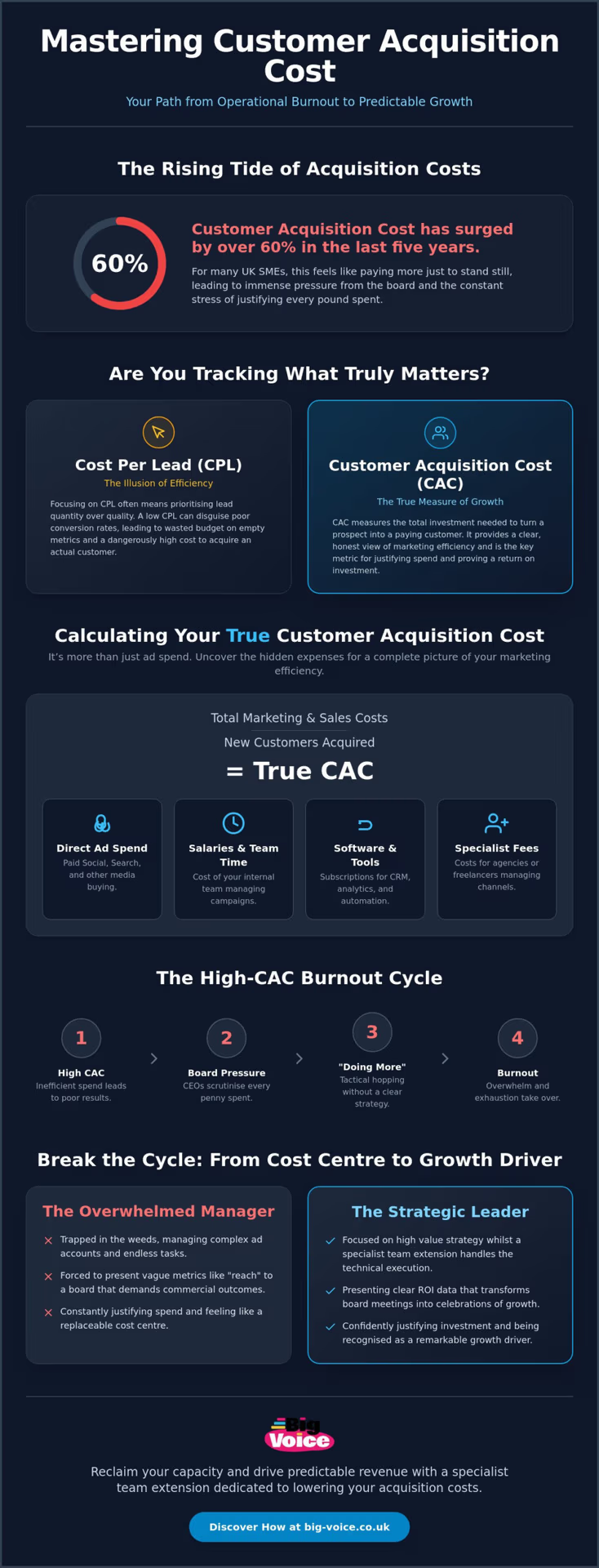
Did you know that customer acquisition cost has surged by over 60% in the last five years? For many UK SMEs, this rising tide makes it feel like you’re paying more just to stand still. You’ve likely felt the sting of operational burnout whilst trying to untangle complex ad accounts or the mounting pressure from your board to prove a return on investment for every £1 spent. It’s frustrating when you aren’t certain which marketing channels are actually profitable and which are simply draining your budget.
We understand that you need more than just metrics; you need a clear path to professional relief. This article promises to help you master the art of calculating and reducing your customer acquisition cost so you can finally eliminate marketing overwhelm and focus on driving measurable commercial outcomes. We’ll provide a breakdown of the 2026 landscape and actionable strategies to help you justify specialist support and secure predictable revenue growth with far less stress.
Key Takeaways
- Discover why treating your customer acquisition cost as a diagnostic tool is the secret to scaling without exhausting your internal resources.
- Identify the hidden expenses, such as software subscriptions and specialist fees, that are often missed when calculating your true marketing efficiency.
- Learn how to break the cycle of operational burnout by shifting from manual task management to a strategy focused on high-value commercial outcomes.
- Explore how specialist management of Paid Social and SEO creates a sustainable path to lower costs and more predictable revenue growth.
- Understand how integrating a specialist team extension allows you to justify marketing spend to the board whilst reclaiming your time.
Understanding Customer Acquisition Cost as a Commercial Growth Driver
In the high-pressure environment of 2026, simply running ads isn’t enough to secure your place in the market. To truly scale, you must look beyond the surface level of your monthly ad spend. At its core, Customer Acquisition Cost (CAC) represents the total investment required to transform a prospect into a paying customer. It’s the ultimate diagnostic tool. If your CAC is climbing whilst your revenue remains stagnant, your marketing engine is likely burning fuel without gaining traction. For UK SMEs, mastering this metric is no longer optional; it’s the difference between sustainable growth and operational burnout.
Many businesses make the mistake of looking only at their direct media spend. True commercial acquisition costs go much deeper. They include everything from software subscriptions and specialist agency fees to the time your internal team spends managing campaigns. When you present your performance to the board, they aren’t looking for engagement or reach. They want to see how efficiently you’re turning capital into customers. Your professional reputation as a marketing manager or business owner rests on your ability to prove that every £1 spent is a calculated step toward a measurable commercial outcome.
The Difference Between CAC and Cost Per Lead
It’s easy to get lured into a false sense of security by a low Cost Per Lead (CPL). You might see hundreds of clicks and enquiries flooding in at a low price point, but if those leads don’t convert, your customer acquisition cost will skyrocket. A low CPL often hides a dangerously high CAC. Shifting your focus toward commercial outcomes means prioritising lead quality over raw quantity. It’s about ensuring your Paid Social and Search efforts are targeting individuals who are ready to buy, not just those who are curious. This change in perspective stops you from wasting budget on empty metrics and starts building a predictable revenue stream.
Why 2026 Demands a More Sophisticated View of Acquisition
The digital landscape has shifted. With UK digital ad spend projected to reach £45 billion this year, competition is fiercer and more expensive than ever. Traditional marketing models are being challenged by the rise of AI search and Generative Engine Optimisation (GEO). These new discovery methods change how users find your brand, often bypassing traditional click-through journeys. To stay ahead, you need a strategy that integrates Paid Search with long term SEO to capture intent across multiple touchpoints. Customer acquisition cost is the ultimate measure of your marketing team’s efficiency in this complex, AI-driven world.
Why High CAC Leads to Marketing Manager Burnout
Managing an inefficient budget feels like carrying a heavy weight every single day. When your customer acquisition cost is too high, you aren’t just losing money; you’re losing sleep. You’re constantly under the microscope. Every penny spent is scrutinised by CEOs who want to see immediate commercial outcomes. This pressure creates a cycle of “doing more”-more campaigns, more platforms, more creative-yet seeing fewer results. It’s exhausting. You become trapped in the weeds of ad accounts instead of steering the strategy. Reclaiming your time starts with optimisation.
Clear ROI data transforms your position within the company. It moves you from being a replaceable cost centre to a remarkable growth driver. When you can prove that your marketing engine is lean and effective, the board’s attitude shifts from scepticism to support. You’re no longer begging for budget; you’re justifying an investment. This clarity is the antidote to operational overwhelm. It allows you to breathe and focus on what you actually enjoy about your role.
The Stress of the Unproven Marketing Spend
Do you dread the monthly reporting meeting? It’s a common feeling amongst marketing managers in small teams of 1-5 people. Without clear data, you’re forced to present vague metrics like “brand awareness” or “reach” to a business owner who only cares about bookings. This lack of clarity leads to tactical hopping. You jump from Paid Social to Search without a plan, hoping something sticks. It’s a recipe for burnout. This is exactly where partnering with a specialist team can provide the technical rigor you lack, turning those awkward board meetings into celebrations of growth.
Creating Capacity Through Efficiency
Efficiency isn’t just about saving money; it’s about reclaiming your capacity. When you lower your customer acquisition cost, you stop being a “task-doer” and start being a commercial leader. You gain the breathing room to think about the big picture. Research shows it costs five times more to acquire a new customer than to retain an existing one, so every efficiency gain in your acquisition funnel is a massive win for the bottom line. By following a structured framework like the Modern Buyer Journey, you can align your Paid Social and Search efforts to reduce friction. This shift allows you to focus on achieving commercial growth rather than just clearing a never-ending to-do list.
How to Calculate Your Real CAC: A Step-by-Step Guide
Ready to face the numbers? Moving from a state of uncertainty to one of total clarity requires a structured approach to your data. Calculating your customer acquisition cost isn’t just a mathematical exercise; it’s a commercial health check that reveals the true efficiency of your growth engine. To get an accurate picture, you must look beyond the basic dashboard metrics and account for every pound that leaves your business in pursuit of a new client.
Follow these steps to determine your CAC with precision:
- Step 1: Aggregate all spend. Pick a specific period, such as the last quarter, and total every penny spent on marketing and sales.
- Step 2: Include hidden costs. Don’t forget software subscriptions, CRM fees, and the specialised support you pay for to keep your campaigns running.
- Step 3: Count new customers. Identify exactly how many new, paying customers were acquired during that same timeframe.
- Step 4: The calculation. Divide your total spend by the number of new customers to find your baseline cost.
- Step 5: The health check. Compare this figure against your Customer Lifetime Value (LTV) to see if your current model is sustainable.
What to Include in Your UK SME Calculation
For a UK SME, the commercial reality of your customer acquisition cost must include more than just your Google or Meta ad spend. You need to factor in the cost of content production, email marketing tools, and even the staff time spent on lead follow ups. If your internal team spends ten hours a week managing Facebook and Instagram accounts, that’s a direct cost to the business. Including these variables ensures you aren’t subsidising your marketing with “free” internal labour, giving you a much more honest view of your profitability.
The LTV to CAC Ratio: The Golden Rule of Scaling
The standard benchmark for a healthy business is a 3 to 1 ratio. This means for every £1 you spend on acquisition, you should expect £3 in lifetime value. For SMEs in Milton Keynes and Bedford, where local competition is high, falling below this ratio can quickly lead to cash flow friction. If your CAC is nearly equal to your customer value, you’re essentially trading £1 for £1, which leaves no room for overheads or profit. A healthy CAC ratio is the foundation of any successful Facebook Ads strategy, allowing you to scale with confidence rather than crossing your fingers and hoping for the best.
Strategic Methods to Reduce CAC Whilst Scaling Your Revenue
Reducing your customer acquisition cost isn’t about simply cutting your budget. It’s about spending smarter. Many businesses treat CAC as a static accounting figure, but in reality, it’s a dynamic lever that responds to every tactical choice you make. By refining your approach to Paid Social and integrating long term discovery through AI search, you can drive more bookings without a linear increase in spend. This is how you move from a state of constant firefighting to a position of scalable, predictable growth. With customer acquisition costs having seen a 222% increase over the last eight years, the ability to pull these levers is what separates market leaders from those who struggle to stay afloat.
Success depends on your ability to reach your Ideal Customer Profile (ICP) with surgical precision. When you target everyone, you pay for everyone. By narrowing your focus to high intent buyers, you stop subsidising the “curious” and start investing in the “ready.” This shift, combined with high converting landing pages that eliminate friction, ensures that your traffic doesn’t just visit; it converts. If your conversion rate doubles, your acquisition cost effectively halves. It’s a simple commercial reality that many overstretched teams overlook whilst buried in daily tasks.
Optimising Paid Social for Commercial Outcomes
Vanity metrics are the enemies of efficiency. Likes and followers might look good in a board deck, but they don’t pay the bills. To lower your customer acquisition cost, your Paid Social strategy must pivot toward commercial outcomes like leads and sales. Specialist management allows you to move beyond basic boosting and into the technical heavy lifting of custom audiences and multi stage retargeting. At Big Voice Ltd, we act as a seamless extension of your team to manage these complexities, ensuring your budget is focused on the 20% of activity that drives 80% of your revenue. Explore our Paid Social specialist services to see how we can lower your costs whilst you focus on high level strategy.
The Role of GEO and AI Search in Modern Acquisition
The discovery landscape is changing rapidly in 2026. As traditional PPC costs continue to climb, Generative Engine Optimisation (GEO) offers a way to capture high intent traffic through AI search results. Ranking in AI Overviews or being cited by ChatGPT Ads provides a “free” long term acquisition channel that balances out your paid media spend. Unlike broad SEO, GEO focuses on how AI models perceive your brand’s authority and relevance. For local UK businesses, this means being the definitive answer for queries in your specific geographical area. This dual approach ensures you aren’t solely reliant on expensive clicks to maintain your growth momentum.
Driving Commercial Outcomes: Your Partner in Lowering Acquisition Costs
Big Voice isn’t just another external agency. We’re the extra capacity you’ve been searching for. We understand the relentless pressure of managing a rising customer acquisition cost whilst your internal resources remain static. By acting as a specialised extension of your team, we take the technical ad management and SEO rigor off your plate. This allows you to breathe. We’re based locally across Milton Keynes, Northampton, and Bedford, providing high level agency expertise with the personal touch and accountability of a local partner. We don’t just deliver reports; we deliver relief.
Our commitment is to your commercial results, not vanity metrics. We know that “brand awareness” doesn’t pay the bills or satisfy a demanding board. You need a partner who is as invested in your leads, sales, and bookings as you are. By handling the complex execution of Paid Social and Search, we ensure your budget is used effectively to drive measurable growth. This collaborative approach moves you away from the stress of unproven spend and toward a state of professional clarity and confidence. If you’re based in Northamptonshire and evaluating your options, our guide to choosing the right marketing agency in Northampton for commercial growth outlines exactly what to look for in a specialist partner.
From Task Manager to Revenue Generator
You shouldn’t be spending your weekends worrying about Meta pixel errors or algorithm shifts. Our expert execution shifts your professional role from a task manager to a revenue generator. We provide the executive level data your CEO actually wants to see, focusing on the bottom line rather than superficial engagement. This prevents operational burnout by ensuring you aren’t doing everything yourself. Instead of being buried in the technical weeds, you’re celebrated for the commercial outcomes you’ve orchestrated. It’s a fundamental change in how you’re perceived by your stakeholders.
Start Your Journey to a More Profitable Marketing Strategy
Scaling your SME in 2026 does not have to mean doubling your stress levels. It’s about finding the right specialist support to optimise your efficiency and protect your margins. We invite you to transform your marketing outcomes by auditing your current customer acquisition cost with a specialist session. Reclaim your time and your results. Final reassurance: growth is possible without the overwhelm when you have the right team behind you. Book a discovery call today to see how we can help you lower your acquisition costs and drive the predictable revenue your business deserves.
Take Command of Your Commercial Growth in 2026
Taking command of your marketing efficiency is the most direct route to professional relief. You now have the tools to move beyond the stress of unproven spend and begin accurately measuring your customer acquisition cost. By shifting your focus toward commercial outcomes and high intent buyers, you ensure that every pound in your budget is working to build a sustainable, scalable future for your business. It’s about moving from a state of being stuck to a state of moving forward with a clear, actionable plan.
As a specialist extension for teams of 1-5, Big Voice is here to handle the technical heavy lifting that often leads to burnout. We prioritise commercial growth over vanity metrics, ensuring your strategy is grounded in real world results. With our 5-star Google review status and deep expertise in the UK market, we’re ready to help you turn your marketing engine into a predictable revenue driver. We don’t just provide services; we provide the capacity you need to succeed in your role.
Don’t let another quarter pass in a state of operational overwhelm. Book a Discovery Call with Big Voice to Optimise Your CAC and start your journey toward a leaner, more profitable strategy. You’ve got the vision; we’ve got the specialist force to make it a reality. Let’s build something remarkable together.
Frequently Asked Questions
What is a good Customer Acquisition Cost for a UK SME?
A good customer acquisition cost is defined by its relationship to your Lifetime Value (LTV) rather than a fixed pound amount. The industry gold standard is a 3:1 ratio. This means if a customer is worth £300 to your business over time, you should aim to spend no more than £100 to acquire them. This balance ensures you have enough margin to cover your operational overheads whilst generating a healthy profit for future scaling.
How is CAC different from Cost Per Acquisition (CPA)?
CAC measures the total investment required to win a new paying customer, whilst CPA focuses on the cost of a specific action like a lead or a click. CPA is a tactical metric used to judge campaign performance. CAC is a comprehensive commercial metric that includes every expense, from ad spend and software subscriptions to specialist fees and internal staff time. It provides the full picture of your marketing team’s efficiency.
Can I reduce my CAC without lowering my total marketing budget?
You don’t need to cut your budget to lower your customer acquisition cost; you simply need to spend it more effectively. By reallocating funds from underperforming channels to those with higher conversion rates, you can drive more bookings for the same investment. Improving your landing page performance and refining your targeting to reach high intent buyers often doubles your results without requiring a single extra penny in total spend.
How often should a small marketing team calculate their CAC?
Calculate your CAC at least once a month to ensure your marketing engine is running efficiently. Small teams of 1-5 people often get buried in daily tasks and miss subtle shifts in platform costs. Monthly reviews allow you to spot rising expenses early and adjust your strategy before they drain your quarterly budget. This regular diagnostic approach provides the clarity you need to justify your spend to the board with total confidence.
Does SEO help in reducing Customer Acquisition Cost over time?
SEO is a vital tool for reducing your customer acquisition cost because it builds a sustainable stream of organic discovery. Unlike paid ads, where traffic stops the moment you stop paying, organic content continues to deliver leads for years. By integrating SEO with your paid strategy, you create a balance that lowers your average cost per lead. This long term approach protects your margins against the rising costs of traditional PPC platforms.
Why is my Facebook Ads CAC higher than my Google Ads CAC?
Google Ads typically captures people with immediate intent, whereas Facebook Ads targets users based on interests whilst they are browsing. Users on Google are often searching for a specific solution, making them quicker to convert. Facebook often requires a more complex funnel with multiple touchpoints to move a user from curiosity to a booking. This longer journey naturally increases the total cost required to win that customer compared to search based intent.
What is the quickest way to lower a high CAC for a local business?
Tighten your geographical targeting to local hubs like Milton Keynes, Northampton, or Bedford to immediately reduce wasted spend. Many UK SMEs waste budget by targeting too broad an area where they cannot easily service the leads. By narrowing your focus to your most profitable postcodes and refining your Ideal Customer Profile, you eliminate clicks from people who are unlikely to convert. This simple shift ensures your budget is reserved for high value prospects.
How do I explain a rising CAC to my business owner or CEO?
Frame a rising CAC as a reflection of the £45 billion UK digital ad market’s increasing competition. Explain that whilst platform costs are rising, you are focused on improving lead quality to maintain a healthy LTV ratio. Show them that you are moving away from vanity metrics to prioritise commercial outcomes. This shift in reporting transforms you from someone spending money into a strategic partner who is actively protecting the company’s long term profitability.
