

What if the traditional marketing funnel is actually the primary source of your team’s operational burnout? You are likely managing a dozen different channels whilst trying to prove that your top of funnel activity actually leads to a sale. It is exhausting to feel like you are shouting into the void without the data to back up your hard work. Fragmented data and the pressure to be everywhere at once can make even the most seasoned marketing manager feel completely under-resourced.
We understand that you need to see results, not just more tasks on your to-do list. This guide will show you how to map and master the modern buyer journey to drive real commercial outcomes and finally reduce that sense of marketing overwhelm. By moving away from vanity metrics and focusing on how customers actually interact with your brand, you can regain control of your strategy and your schedule.
We will provide a clear framework to organise your marketing activity, showing you how to align paid social with search intent and turn fragmented touchpoints into a reliable stream of leads and sales.
Key Takeaways
- Shift your focus from vanity metrics to real commercial growth by understanding the total experience of the modern buyer journey.
- Identify the specific emotional states your customers experience during the awareness, consideration, and decision stages to deliver more relevant messaging.
- Master the complex space between trigger and purchase by adapting your strategy for AI search and Generative Engine Optimisation.
- Implement a practical framework to audit your local touchpoints and align your marketing activity with the specific pain points of your customers.
- Discover how a collaborative partnership can manage technical execution like Paid Social and SEO to reduce your team’s operational burnout.
What is the Buyer Journey and Why Does it Matter for Your SME?
Managing a small marketing team of one to five people often feels like a constant race against the clock. You are pressured to deliver specialist results across search, social, and email, yet you rarely have the technical headcount to dive deep into the data. This operational burnout is real. It stems from a fragmented approach where you are managing channels rather than experiences. To move away from this cycle of stress, you must shift your focus toward the total experience a customer has with your brand, both before and after they click the buy button.
Understanding this path is the fundamental difference between chasing vanity metrics and achieving genuine commercial outcomes. Whilst a spike in Instagram likes might look good in a monthly report, it doesn’t necessarily translate to bookings or sales if those interactions aren’t moving the needle. By mapping the buyer decision process, you can identify exactly where potential customers are dropping off and which touchpoints are actually driving revenue. The buyer journey is the strategic framework used to align marketing touchpoints with customer intent.
The Shift from Funnels to Flywheels
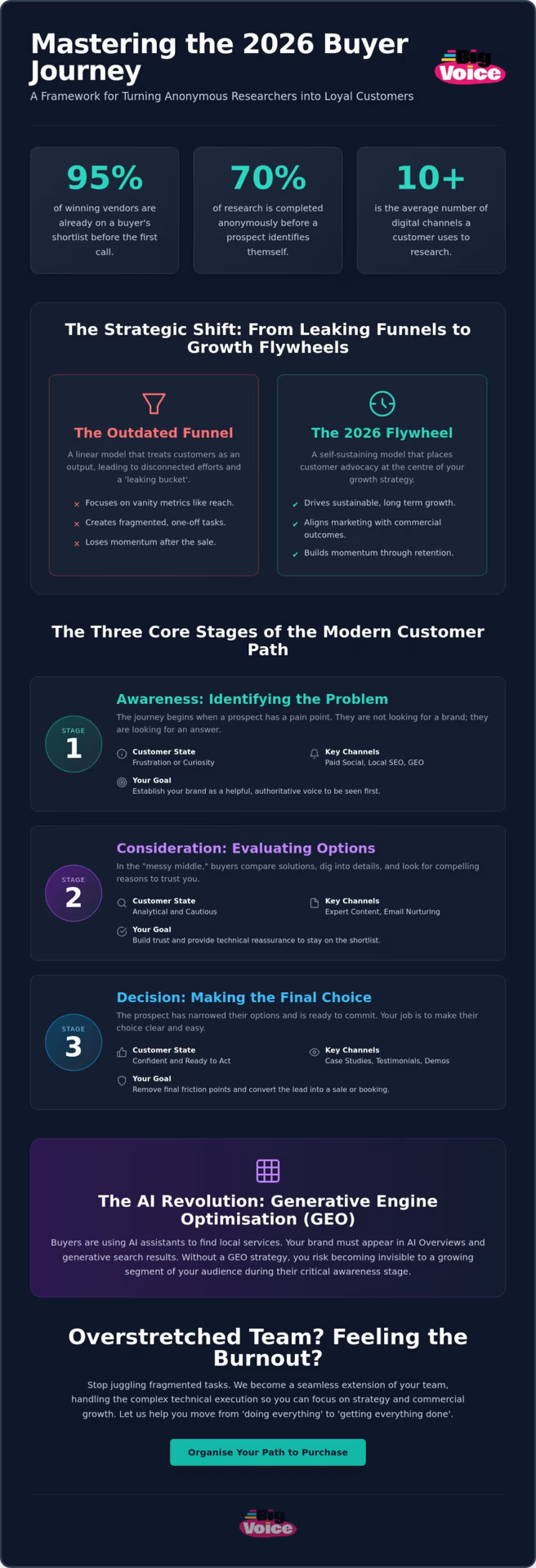
By 2026, the traditional linear funnel will be considered a relic. Customers don’t just drop in at the top and pop out at the bottom; they loop, revisit, and advocate. Transitioning to a flywheel model helps alleviate marketing manager burnout by prioritising sustainable growth over the constant, exhausting hunt for new leads. When you focus on retention and advocacy as part of the buyer journey, your existing customers become a secondary sales force, reducing the pressure on your paid acquisition channels.
Why SMEs in Milton Keynes and Northampton Need a Map
For businesses operating in hubs like Milton Keynes or Northampton, local relevance is your greatest asset. The digital path to purchase is becoming increasingly fragmented, with local competition fighting for the same eyeballs. You cannot afford to guess where your budget goes. A sophisticated approach to search and social is required to stand out amongst the noise.
In the early awareness stages, your presence in Google AI Overviews and local search results is critical. This is where SEO services in Milton Keynes and Northampton become vital. Implementing Generative Engine Optimisation (GEO) ensures your brand is the one being recommended when a local buyer asks an AI tool for the best solution in their area. Without a clear map of these local touchpoints, you risk wasting spend on broad campaigns that fail to convert into local commercial results.
The Three Core Stages of the Modern Customer Path
Mapping the buyer journey requires looking past spreadsheets and into the minds of your audience. In 2026, the path to purchase is a sophisticated blend of emotional triggers and digital touchpoints. If your marketing team is currently juggling too many channels, categorising your activity into these three core stages will provide much needed clarity and focus. It allows you to move away from reactive task management toward a strategic, outcome-led approach.
Awareness: Identifying the Problem
At this stage, your potential customer is often in a state of mild frustration or curiosity. They don’t know your brand exists yet; they only know they have a problem that needs solving. Their emotional state is focused entirely on this pain point. For local audiences in areas like Milton Keynes, Facebook Ads can act as a powerful trigger. These ads don’t just show a product; they mirror the user’s current struggle and offer a glimpse of a solution. Whilst many teams get distracted by vanity metrics like total impressions, the real goal here is relevance. Are you being found through search and social when the problem arises, or are you just adding to the digital noise?
Consideration: Evaluating the Options
Once the problem is defined, the buyer enters an analytical and often sceptical emotional state. They are actively comparing your solution against your local and national competitors. This is the “messy middle” where technical authority is won or lost. You must provide expert content that proves you understand their specific industry challenges. Email marketing becomes your silent partner here, nurturing leads with high value insights whilst they weigh up their options. If you feel your team lacks the capacity to produce this level of technical depth, exploring professional marketing support can help bridge the gap without increasing your permanent headcount.
Decision: The Final Conversion
The final stage is where the emotional state shifts to one of decisive caution. The buyer is ready to act but is looking for any reason to hesitate or delay. Your job is to remove every ounce of friction from the point of sale or booking. This is where social proof, case studies, and clear commercial data become essential. A specialist social media marketing agency for small business ensures that the final retargeting ads and conversion prompts are perfectly timed. They turn a “maybe” into a confirmed booking by providing the reassurance needed to click that final button.
Why Linear Journeys are a Myth in 2026
Most generic marketing blogs still teach a linear model that belongs in the 1950s. They suggest that customers move neatly from A to B to C; however, the reality of the modern buyer journey is far more chaotic. We call this the “Messy Middle”. It is a complex, looping space between the initial trigger and the final purchase where potential customers bounce between exploration and evaluation. They might discover you on social media, research you via an AI tool, visit your site, leave to check a competitor, and then loop back to the awareness stage all over again.
If you feel exhausted trying to track every single move a customer makes, you aren’t alone. This non-linear behaviour is exactly why generalist marketing managers feel a sense of permanent burnout. You are expected to manage a web of interactions rather than a straight line, often without the technical tools to see the full picture. Recognising that the journey is a loop rather than a funnel is the first step toward regaining your professional clarity.
The Influence of AI Search and GEO
The way buyers gather information has shifted fundamentally with the rise of ChatGPT and Google AI Overviews. People no longer just type keywords into a search bar; they ask complex, conversational questions. This has given birth to Generative Engine Optimisation (GEO). Ranking in these AI summaries is now just as critical as appearing in traditional search results. It requires a specific type of technical authority to ensure your brand is the one the AI recommends. If your team is already overstretched, keeping up with these shifts in SEO services and ChatGPT ads can feel like an impossible task.
Multi-Channel Attribution Challenges
In 2026, it is nearly impossible to credit a single ad or post for a final sale. A customer might see three Facebook ads, read two blog posts, and receive an email before they finally convert. Trying to prove the value of a single channel based on clicks alone is a recipe for frustration. You must shift your focus toward commercial outcomes rather than individual channel metrics. Big Voice – Digital Marketing Agency acts as an extension of your team to provide clear ROI reporting that looks at the big picture. By focusing on total leads and revenue growth, we help you move away from the stress of defending individual line items in your budget and toward being celebrated for the results you deliver.
Mapping Your Local Buyer Journey for Commercial Outcomes
Generic marketing guides often suggest using “big data” to track every customer move, but for an SME in the Home Counties, this approach is often impractical and overwhelming. You don’t need a data science degree to master your buyer journey; you need a clear, local map that leads directly to commercial results. By focusing on your specific territory, you can stop shouting at the entire internet and start talking to the people most likely to book your services or buy your products.
How do you begin this process without adding more stress to your already overstretched team? Follow these four practical steps to organise your activity:
- Step 1: Identify your ICP and local pain points. Go beyond basic demographics. What specific challenges do your customers in Milton Keynes or Northampton face? Identify the “trigger” that makes them look for a solution like yours.
- Step 2: Audit your local touchpoints. Look at your presence from a local perspective. If someone searches for your service whilst sitting in a cafe in Bedford, what do they see? Audit your Google Business Profile, local landing pages, and social mentions.
- Step 3: Align content with intent. Ensure your Paid Social and PPC campaigns match the stage of the journey. Don’t ask for a sale in the awareness stage; provide helpful, local expertise instead.
- Step 4: Focus on commercial tracking. Stop reporting on likes and impressions. Implement tracking that shows exactly how many leads, bookings, or sales originated from each stage of the path.
Local Search Intent in the Home Counties
Search behaviour isn’t uniform. A customer in Luton might use different terminology or have different priorities compared to someone in Northampton. Recognising these nuances allows you to implement geographical optimisation that captures “near me” searches effectively. By leveraging local social proof, such as testimonials from recognisable local businesses, you build faster trust during the consideration stage. This proximity creates a sense of reliability that national competitors simply cannot match.
Building Your Marketing Tech Stack
You don’t need a developer to build a tech stack that tracks the buyer journey. Modern SMEs can use accessible tools to integrate CRM data with paid social performance. This gives you a clear view of which ads are driving actual revenue, not just traffic. However, managing this technical complexity whilst running daily operations is often the tipping point for manager burnout. If you are ready to move from operational stress to commercial clarity, our team can act as the specialist force you need to manage these technical executions. Explore how we provide expert marketing support to help you scale without the overhead of a large internal team.
How Big Voice – Digital Marketing Agency Becomes an Extension of Your Marketing Team
Most agencies pitch themselves as outside vendors who simply manage a Facebook page or tick off a task list. We do things differently. Our “Extension” philosophy means we don’t just work for you; we work amongst your team. We understand that you’re likely feeling the weight of managing a complex buyer journey whilst lacking the technical headcount to execute every detail. By integrating our specialists directly into your workflow, Big Voice – Digital Marketing Agency provides the capacity you need to breathe again. You gain high-level agency capabilities with the warmth and approachability of a local partner.
We take over the technical execution of your Paid Social, SEO, and ChatGPT Ads. This isn’t just about outsourcing tasks; it’s about building an engine that moves customers through the path to purchase with precision. We focus on real-world impact over superficial metrics. If a specific campaign doesn’t lead to a booking or a sale, it isn’t our priority. Our goal is to ensure your marketing spend is an investment in growth, not just an operational expense.
From Replaceable to Remarkable
One of the biggest pains for marketing managers is proving the commercial value of their work to a CEO or business owner. Big Voice – Digital Marketing Agency helps you shift that narrative entirely. Our reporting is designed to make you look like a hero by providing the executive-level data needed to justify every pound of marketing spend. We don’t just report on clicks or likes; we report on revenue and ROI. By showing how each stage of the buyer journey contributes to the bottom line, we help move your role from being seen as a cost centre to being celebrated as a growth driver. We provide the clarity you need to walk into any board meeting with total confidence.
Take the First Step Toward Relief
It’s time to stop “doing everything” and start “getting everything done.” You don’t have to carry the burden of technical execution alone. Imagine having a proactive, reliable team of specialists who are as invested in your professional reputation as you are. We don’t believe in abstract theory; we believe in commercial results that change the trajectory of your business.
We invite you to book a discovery call with Big Voice – Digital Marketing Agency today. Let’s sit down for a strategy session to map your specific path to purchase and create a plan that delivers the leads, sales, and bookings you need. Take the first step toward professional relief and commercial clarity today.
Move from Operational Burnout to Commercial Clarity
Mastering the modern customer path to purchase doesn’t have to be a source of constant stress for your small team. You’ve seen how shifting from a linear funnel to a flywheel model protects your time whilst driving genuine commercial results. By embracing local search intent and specialised tactics like GEO, you can finally move away from vanity metrics and focus on what truly matters: leads, sales, and bookings.
Big Voice – Digital Marketing Agency prides itself on being the empowering expert sidekick that makes you look remarkable to your stakeholders. With our 5-star Google review status and a proven track record helping local anchors like Cranfield University, we bring technical rigour to your Paid Social and GEO strategy. You don’t have to manage every channel alone. Let us act as the seamless extension of your team, handling the technical execution of your buyer journey whilst you focus on the big picture.
Stop the overwhelm and start scaling—let us map your buyer journey for you. It’s time to trade professional friction for measurable success and reclaim your peace of mind.
Frequently Asked Questions
What is the most important stage of the buyer journey?
The most important stage is whichever one is currently leaking potential revenue for your business. Whilst awareness gets you found, the consideration stage is often where technical authority is won or lost. This is where buyers compare your expertise against local competitors. If you don’t provide value here, you lose the sale before the decision stage even begins. Focusing on the messy middle ensures your team isn’t just generating noise.
How long does a typical SME buyer journey take in 2026?
There is no single timeframe, but B2B journeys in 2026 often span several weeks or months due to fragmented search loops. Buyers now consult AI tools, social proof, and multiple websites before committing. For smaller purchases, the cycle might only take a few days. The key is to have touchpoints ready whenever they loop back. Understanding this timing helps you manage expectations with your CEO regarding when leads will actually convert.
Can I map the buyer journey without expensive software?
You absolutely don’t need a massive budget or complex software to start mapping. Simple tools like Google Search Console and basic CRM data provide enough insight to identify where customers are engaging. Customer interviews are also incredibly valuable. Ask your last five clients how they found you and what made them hesitate. This qualitative data is often more powerful than expensive tracking software for an overstretched SME team.
How does Paid Social influence the awareness stage?
Paid Social acts as the primary emotional trigger that moves a person from passive observation to active problem recognition. By using Facebook or Instagram Ads, you can mirror a customer’s specific frustration before they’ve even searched for a solution. It places your brand at the very start of the buyer journey. This proactive approach ensures you aren’t just waiting for search intent but are actively creating it within your local territory.
What is the difference between a buyer persona and a buyer journey?
A buyer persona defines who your customer is, whilst the buyer journey maps the specific actions they take over time. Think of the persona as the character in a story and the journey as the plot. You need both to be successful. Knowing that your customer is a busy SME owner is helpful, but knowing they search for solutions at 9pm on LinkedIn is what allows you to target your budget effectively.
How do I track a customer who moves between offline and online touchpoints?
Bridging the gap between offline and online touchpoints requires simple, trackable triggers. Use unique QR codes on physical signage or specific discount codes for in-person events that lead back to a dedicated landing page. Integrating this data into your CRM allows you to see the full picture. It stops you from guessing which offline activities are driving digital sales, providing the commercial clarity your team needs to justify your marketing spend.
Why is my buyer journey map not resulting in more sales?
If your map isn’t converting, there is likely a disconnect between customer intent and your content. You might be providing awareness content when the buyer is ready to make a decision. Friction at the point of sale, such as a complex booking form or lack of social proof, can also stall the process. Audit your final touchpoints to ensure you are removing hurdles rather than creating them for your potential customers.
How often should I update my buyer journey map?
Aim to review your map at least once a quarter to stay aligned with shifting digital behaviours. The rise of AI search and Google AI Overviews means the way people find information changes rapidly. You don’t need a total overhaul every time, but a quick check ensures your touchpoints are still relevant. Regular updates prevent your strategy from becoming stagnant and help you avoid the burnout of running outdated, ineffective campaigns.
