

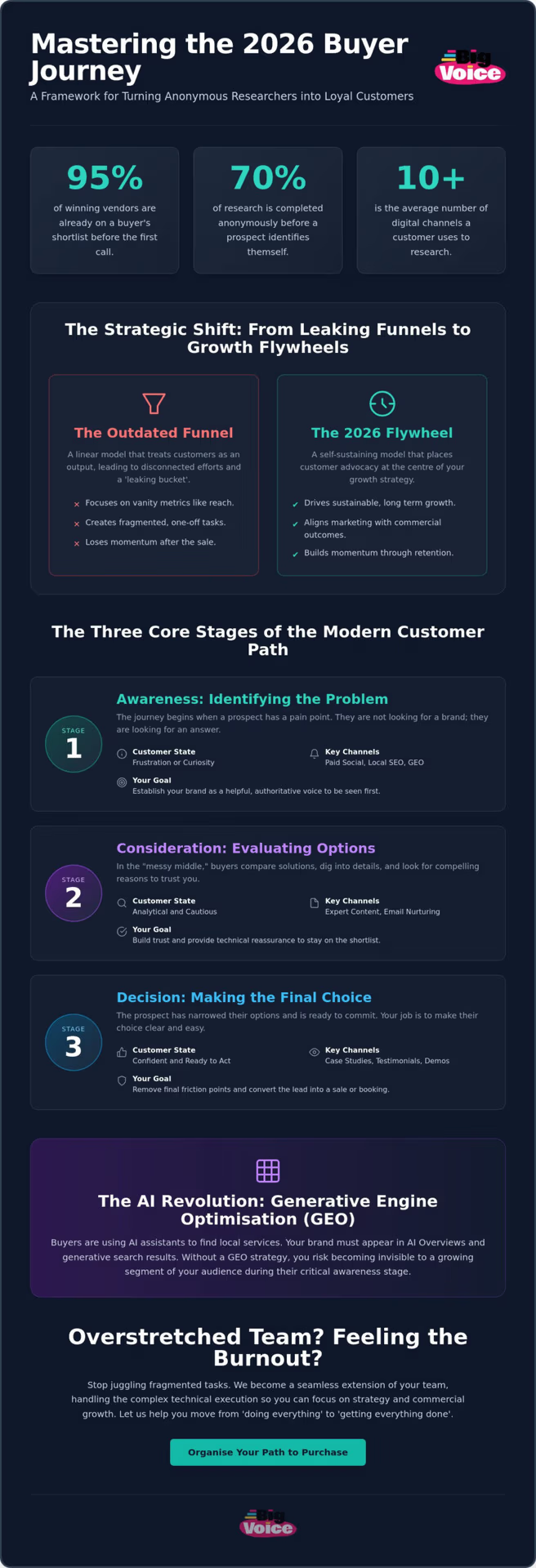
Did you know that 95% of winning vendors are already on a buyer’s shortlist before they even pick up the phone? In 2026, the buyer journey has transformed into a complex, anonymous process where your potential customers complete up to 70% of their research without ever identifying themselves. It is no longer a simple funnel. It’s a series of micro-moments happening across an average of ten different digital channels.
You likely feel the weight of this shift every day. Managing fragmented data and trying to prove the commercial value of brand awareness whilst your team is already stretched to its limit is a recipe for burnout. We understand that pressure. This guide provides a clear framework to organise your marketing activity and master the path to purchase to drive real commercial outcomes. We will show you how to align paid social with search intent and use relevant messaging to turn anonymous researchers into loyal leads and sales.
Key Takeaways
- Understand why mastering the modern buyer journey is the essential first step to moving away from vanity metrics toward measurable commercial growth.
- Identify the specific emotional states of your customers during the Awareness, Consideration, and Decision stages to ensure your messaging remains relevant.
- Learn how AI search and Generative Engine Optimisation are changing how buyers research products and how you can stay visible in these new search results.
- Discover a practical framework to audit your digital touchpoints and better align your paid social activity with actual search intent.
- Explore how a specialist team extension can handle complex technical execution to relieve operational burnout and help you focus on broader business goals.
What is the Buyer Journey and Why Does it Matter for Your SME?
Your brand is more than just a logo or a single advert. It is the sum of every interaction a customer has with you. We define the buyer journey as the total experience a customer has with a brand before and after a purchase. For many SMEs, this path is often treated as a series of disconnected tasks. You might be running Facebook Ads, posting on Instagram, and trying to keep up with SEO, but without a cohesive strategy, these efforts often result in vanity metrics like reach or impressions rather than genuine commercial outcomes. Understanding this path is the difference between simply being seen and actually being chosen.
The pressure on marketing managers today is immense. You are often expected to be a specialist in everything from PPC to content creation without the headcount to support it. This lack of resource leads to operational burnout and fragmented data that makes it impossible to see what is actually working. By understanding the buyer decision process, you can move away from the stress of doing everything and start getting everything done with purpose. The buyer journey is the strategic framework used to align marketing touchpoints with customer intent.
The Shift from Funnels to Flywheels
Traditional funnels suggest a beginning and an end. In 2026, that linear model is officially dead. We now look at the flywheel. This approach places customer retention and advocacy at the heart of your growth strategy. When you focus on the entire buyer journey, including what happens after the sale, you create a self sustaining loop of growth. This shift is vital for avoiding marketing manager burnout. It allows your team to focus on high impact activity that drives sustainable results rather than constantly chasing new leads to fill a leaking bucket.
Why SMEs in Milton Keynes and Northampton Need a Map
If you are an SME in Milton Keynes or Northampton, the digital landscape is uniquely crowded. Local relevance is your biggest asset, but fragmented competition requires a more sophisticated approach to search and social. Buyers in these areas are increasingly using AI assistants to find services. This is where local SEO and GEO (Generative Engine Optimisation) become critical. In the early awareness stages, your brand needs to appear as a recommended solution in AI generated overviews. Mapping your local journey ensures you are visible exactly where your customers are looking, providing a clear path from a local search to a confirmed booking. Working with a specialist marketing agency in Northampton can provide the local expertise and technical execution needed to maintain that visibility across every stage of the path to purchase.
The Three Core Stages of the Modern Customer Path
Mapping out the buyer journey requires a deep understanding of human psychology and digital behaviour. It isn’t just about where people click. It is about how they feel at every touchpoint. In 2026, we categorise this experience into three distinct stages: Awareness, Consideration, and Decision. Each phase demands a different set of tools and a specific tone of voice to move the prospect forward without causing friction.
Awareness: Identifying the Problem
The journey begins when a potential customer realises they have a specific pain point. At this moment, their emotional state is often one of frustration or curiosity. They aren’t looking for a brand yet. They are looking for an answer. For local SMEs, Facebook Ads are a powerful way to trigger this stage by putting your solution in front of a relevant audience before they even search for it. Whilst many teams overly prioritise impressions here, the real goal is to establish your brand as a helpful authority. SEO and Paid Social work together in this phase to ensure you are the first name they see when the problem arises.
Consideration: Evaluating the Options
Once the problem is defined, the buyer enters the messy middle. This is where they compare different solutions and look for reasons to trust you. Research indicates that Mastering the Buying Journey during this stage involves providing high quality content that addresses technical concerns. Buyers in 2026 are more independent than ever. They often complete 70% of their research anonymously. You must use email marketing and expert content to nurture these leads. This builds the trust required to keep you on their shortlist whilst they evaluate your competitors. If you find your team is struggling to produce this volume of content, our experts can act as a seamless extension of your marketing department to handle the heavy lifting.
Decision: The Final Conversion
The final stage is where the commercial outcome happens. The buyer’s emotional state shifts to one of validation. They want to be sure they are making the right choice. To secure the conversion, you must remove every possible point of friction from the booking or checkout process. Social proof, case studies, and executive level data are essential here. A specialist social media marketing agency for small business ensures your messaging remains consistent across all platforms. By aligning your paid search intent with these decision phase triggers, you turn interest into measurable sales growth across the entire buyer journey.
Why Linear Journeys are a Myth in 2026
Most marketing textbooks still teach a linear path. It is a comforting lie. In reality, the buyer journey in 2026 is a tangled web of micro moments. Google famously describes this as the “Messy Middle”. It is a complex space where customers loop between exploration and evaluation. They might see an Instagram post, read a technical guide, then loop back to the awareness stage when a new AI tool suggests a different approach. This isn’t a straight line. It is a cycle that often spirals back on itself.
If you feel overwhelmed trying to track this buyer journey, you aren’t alone. Generalist marketing managers are often blamed for “leaky funnels” that don’t actually exist. The truth is that the path to purchase has simply become more erratic. Trying to map this manually whilst managing a small team is a recipe for operational burnout. You need clarity, not more tasks.
The Influence of AI Search and GEO
AI search is the biggest disruptor since the smartphone. Tools like ChatGPT and Google AI Overviews are fundamentally changing how people gather information. Buyers no longer just scroll through a list of links. They read generated summaries that synthesise multiple sources. Ranking in these AI summaries is now as critical as traditional SEO. This requires specialised Generative Engine Optimisation (GEO). It is a technical, data intensive process that focuses on how AI models perceive your brand authority. Without specialist support, staying visible in these AI overviews is nearly impossible for overstretched teams.
To explore how these advancements are redefining B2B sales, check out Global AI Reps and their insights on autonomous revenue in 2026.
Multi Channel Attribution Challenges
Attributing a sale to a single ad is nearly impossible now. A conversion might be the result of ten different touchpoints across three months. Instead of getting lost in individual channel clicks, we prioritise commercial outcomes. We look at the bottom line. By acting as a specialist extension of your team, we provide the technical rigor required to report on real ROI. We consolidate fragmented data to show you what is actually driving leads and sales. This allows you to stop worrying about individual metrics and start celebrating actual growth.
Mapping Your Local Buyer Journey for Commercial Outcomes
Moving from the theory of the “messy middle” to a practical, local strategy requires a structured approach. You don’t need a global budget to master your buyer journey. You simply need a map that reflects how people in your specific area actually behave. By following these four steps, you can transform your marketing from a source of stress into a predictable engine for growth. For those looking for an affordable way to build a professional online presence, you can visit Good Budget Website to see how their tailored packages support small business growth.
- Step 1: Identify your Ideal Customer Profile (ICP). Go beyond basic demographics. Focus on the specific local pain points your customers face in the Home Counties. Are they commuting into London? Are they looking for local reliability?
- Step 2: Audit your current touchpoints. Look at your brand from a Milton Keynes or Northampton perspective. Does your Google Business Profile match the messaging on your Instagram Ads? Consistency builds trust.
- Step 3: Align content and ads with intent. Stop using Awareness stage ads to push for a Decision stage sale. Match your messaging to the buyer’s emotional state.
- Step 4: Implement tracking for commercial outcomes. Shift your focus away from likes and shares. Track leads, phone calls, and bookings to see what actually drives revenue.
Local Search Intent in the Home Counties
Search behaviour isn’t uniform across the region. A customer in Luton might use different language or have different priorities than one in Bedford or Northampton. Geographical optimisation is about more than just adding a town name to your website. It involves capturing “near me” searches by appearing in local AI overviews and map packs. Use local social proof, such as testimonials from recognisable local businesses, to build faster trust during the consideration stage. This local relevance acts as a shortcut through the complex evaluation process. If you are based in the region and want to understand how to select the right partner for this work, our guide to choosing a marketing agency in Northampton for commercial growth outlines exactly what to look for.
Building Your Marketing Tech Stack
You don’t need a developer to track the buyer journey effectively. SMEs can now use accessible tools to integrate CRM data with paid social performance. This gives you a clear view of which ad actually resulted in a sale. However, managing this technical complexity whilst running a business is often where the burnout happens. A specialist partner can bridge this gap. We act as a technical force that organises your data, ensuring your tech stack serves your commercial goals rather than creating more work for your team. If you are ready to stop guessing and start growing, we can help you optimise your local marketing strategy for real results.
How Big Voice Becomes an Extension of Your Marketing Team
Most agencies treat you as a ticket in a queue. We don’t. Our “Extension” philosophy means we work amongst your team, not just for it. We understand that managing the modern buyer journey across ten different channels is a full time job in itself. By taking over the complex technical execution of your Paid Social, SEO, and GEO, we provide the professional relief you need to focus on broader strategy. You don’t need another vendor. You need a specialist partner who is as invested in your commercial outcomes as you are.
We act as the technical force that makes your internal structure more efficient. Instead of adding more tasks to your plate, we remove the burden of technical management. This collaborative approach allows us to align your marketing activity with actual customer intent, ensuring that every touchpoint we manage contributes directly to your bottom line. We aren’t an outside entity. We are the added capacity your team has been missing.
From Replaceable to Remarkable
Your professional reputation depends on results. Our reporting is designed to make marketing managers look like heroes to their CEOs and stakeholders. We move past superficial vanity metrics to provide the executive level data needed to justify every pound of marketing spend. Whether it’s tracking leads from a Facebook ad or sales from an AI search result, our commitment is always to commercial results. We prioritise revenue over reach because we know that bookings and sales are what actually drive business growth. By providing clear, actionable ROI data, we help you prove the value of your department and secure the budget you need for future expansion.
Take the First Step Toward Relief
It is time to stop trying to do everything and start getting everything done. The complexity of the 2026 buyer journey doesn’t have to be a source of stress. With the right support, it becomes your greatest competitive advantage. We invite you to join us for a strategy session where we will map your specific path to purchase and identify the gaps in your current funnel. Book a discovery call with Big Voice today and discover how a seamless team extension can transform your marketing performance whilst giving you your time back. Let’s move you from a state of overwhelm to a position of clarity and commercial success.
Master Your Marketing Path and Reclaim Your Time
Navigating the modern buyer journey doesn’t have to be a source of professional friction. We have explored how the shift toward non-linear paths and AI search requires a new level of technical authority. By aligning your local intent with specialist execution, you move from a state of being burdened by tasks to being celebrated for commercial outcomes. You don’t have to manage this complexity alone.
As experts in Paid Social and GEO, we provide the specialist support needed to turn fragmented data into clear ROI. Our 5-star Google review status and proven track record with local anchor clients, such as Cranfield University, reflect our dedication to your success. We act as the proactive sidekick that makes your marketing department look remarkable to every stakeholder. It’s time to stop the cycle of burnout and start focusing on the growth your business deserves.
Stop the overwhelm and start scaling—let us map your buyer journey for you
You have the vision for your brand. We have the technical force to make it a reality. Let’s move forward together with a clear plan for your next big win.
Frequently Asked Questions
What is the most important stage of the buyer journey?
The Awareness stage is the most critical because it determines whether you even make the buyer’s initial shortlist. Research shows that 95% of winning vendors are decided before a customer ever contacts a sales team. If you aren’t visible during the early research phase, you won’t be considered for the final commercial outcome.
How long does a typical SME buyer journey take in 2026?
A typical buyer journey in 2026 is shorter than in previous years, with many buyers engaging with sellers six to seven weeks earlier than they did in 2024. Whilst the duration depends on the complexity of your service, the anonymous research phase remains the longest part of the process. Most customers now complete up to 70% of their research before identifying themselves to your team.
Can I map the buyer journey without expensive software?
You don’t need expensive software to map the customer path effectively. A simple spreadsheet or even a whiteboard session with your team is enough to identify key touchpoints and local pain points. The value lies in the strategy and understanding of customer intent rather than the technical tools used to document it. Focusing on human behaviour is always more effective than relying on complex automation.
How does Paid Social influence the awareness stage?
Paid Social triggers the Awareness stage by placing your solution in front of potential customers before they actively search for it. It uses demographic and behavioural data to identify people likely to have a problem you can solve. This proactive approach ensures you are the first brand they consider when they move into the evaluation phase. It is about creating a “trigger” moment rather than just waiting for a search query.
What is the difference between a buyer persona and a buyer journey?
A buyer persona identifies who your customer is, whilst the buyer journey maps the specific actions they take to reach a purchase. Think of the persona as the character in a story and the journey as the plot. You need both to ensure your messaging is relevant to the right person at the right time. Personas focus on demographics and pains, whilst the journey focuses on timing and touchpoints.
How do I track a customer who moves between offline and online touchpoints?
Tracking customers across offline and online touchpoints requires integrated tools like unique QR codes or trackable phone numbers. By using a CRM that links these physical interactions to digital profiles, you can see exactly where a local enquiry originated. This prevents data fragmentation and helps you understand which local events or ads are actually driving commercial growth. It bridges the gap between a physical shopfront and a digital ad.
Why is my buyer journey map not resulting in more sales?
If your map isn’t driving sales, there is likely a gap between your messaging and the customer’s emotional state. You might be pushing a hard sell when the buyer is still in the exploration phase. Auditing your touchpoints for friction, such as slow response times or complex booking forms, usually reveals why leads aren’t converting into revenue. Alignment between intent and messaging is the key to conversion.
How often should I update my buyer journey map?
You should update your map at least every six months or whenever there is a significant shift in search technology. With the rapid rise of AI search and GEO, buyer behaviour changes quickly. Regular reviews ensure your marketing activity remains aligned with how customers are actually finding and evaluating services in your local area. Staying static in a fast moving digital landscape is a recipe for losing market share. As part of these regular reviews, it is also worth examining your customer acquisition cost to ensure your marketing spend is delivering profitable growth rather than simply generating activity.
