

What if the reason your marketing team feels perpetually behind isn’t a lack of effort, but a lack of focus? Most businesses treat the ideal customer profile as a static document that sits in a folder gathering dust, whilst they continue to burn budget on broad audiences that never actually convert. It’s a common struggle. You’re likely exhausted from managing a flood of poor quality leads that go nowhere, all while facing intense pressure to prove ROI without the internal headcount to do deep analysis. It’s a frustrating cycle that leads straight to burnout for even the most resilient marketing managers.
We’re here to help you break that cycle. You’ll learn how to master the art of identifying your most profitable customers to eliminate marketing waste and drive measurable commercial outcomes. This article provides a clear and actionable framework to align your sales and marketing teams through a dynamic data model. By the end, you’ll have a scalable digital strategy that feels like a seamless extension of your team, delivering higher quality leads that convert faster and ensuring your business is found by the 50% of consumers now using AI search.
Key Takeaways
- Learn to distinguish between company level data and individual personas to focus your budget where it actually drives growth.
- Identify the specific firmographic and technographic markers that define your most profitable accounts to stop chasing poor quality leads.
- Discover a step by step framework to audit your current client base and build a high performing ideal customer profile that aligns your sales and marketing efforts.
- Understand why a narrow focus is now essential for ranking in AI search summaries and staying visible amongst the competition.
- Transition from operational burnout to commercial success by using your profile to guide an expert team extension that handles the heavy lifting.
The Foundation of Commercial Growth: What is an Ideal Customer Profile?
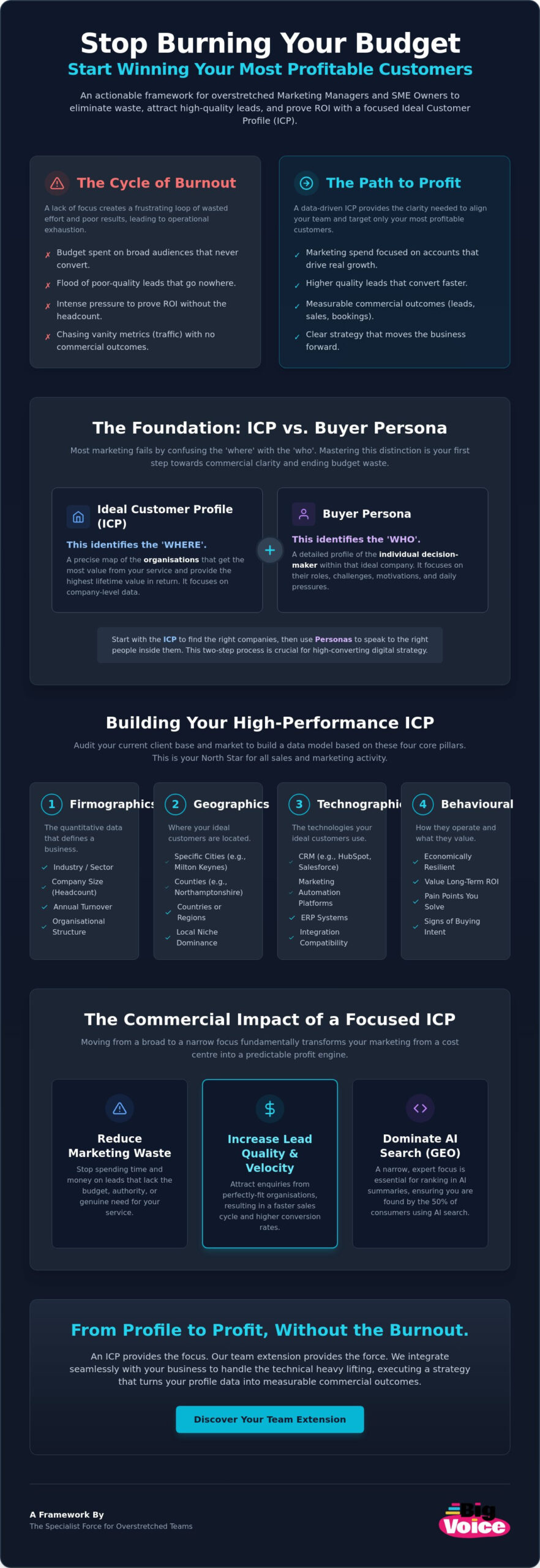
Imagine waking up to an inbox full of enquiries that actually fit your business model. For many marketing managers in Milton Keynes and Northampton, the reality is far more draining. You’re likely sifting through a sea of low quality leads that lack the budget or the genuine need for what you offer. This is where an Ideal Customer Profile (ICP) becomes your most essential commercial tool. An ICP isn’t just a basic description of a company. It’s a precise, firmographic map of the organisations that derive the most value from your services and provide the highest lifetime value in return. It serves as your North Star, ensuring every pound of your marketing spend is targeted at accounts that drive real growth. By defining these parameters, you reduce the operational friction that often slows your team down and leads to unnecessary burnout.
ICP vs. Buyer Persona: Clearing the Confusion
Confusion often arises when teams use these terms interchangeably. The ideal customer profile identifies the “where” by focusing on business level data such as industry, annual turnover, and employee count. The persona identifies the “who,” drilling down into the individual decision maker’s daily pressures and professional motivations. These frameworks work together to build a high converting digital strategy by ensuring you’re reaching the right person at the right organisation. SMEs often fail by skipping the ICP and jumping straight to personas, which leads to high engagement from businesses that simply cannot afford their services. Without the organisational context, your marketing efforts are essentially flying blind.
The Big Voice Ltd Approach to ICPs
We believe that a well defined profile is the primary cure for operational overwhelm. By narrowing your focus, you can finally move from a state of being burdened by tasks to a feeling of moving forward with a clear plan. A lack of focus leads directly to the vanity metric trap, where high traffic figures lead to zero commercial outcomes. This isn’t about doing more work; it’s about doing the right work. When you adopt our approach, you gain a specialist force that integrates into your team to handle the technical heavy lifting. We prioritise commercial outcomes like leads and sales over superficial metrics, ensuring you are celebrated for the results you deliver to your stakeholders. This team extension model provides the professional relief you need to scale effectively.
Firmographics and Technical Variables: The Marketing Manager’s Deep Dive
Building a high performing ideal customer profile requires looking past surface level traits. For an overstretched marketing manager, this means diving deep into firmographics: the structural data that defines a business. You need to pin down the specific industries where your solution thrives, the company size that has the budget to pay you, and the annual revenue brackets that signal commercial stability. These variables aren’t just numbers on a spreadsheet. They are the filters that protect your time and ensure your marketing spend isn’t wasted on leads that lack the capacity to convert. It’s about precision over volume.
Technographics add another layer of certainty to your strategy. Does your ideal client use HubSpot, Salesforce, or a bespoke legacy system? Knowing their tech stack tells you if your service will integrate seamlessly or if you’ll face a technical uphill battle. When you align your offerings with their existing tools, you position yourself as a collaborative partner rather than just another vendor. Environmental factors also play a vital role. Economic shifts in the UK market mean you must target businesses that remain resilient. With 90% of shoppers expressing concern about the economy in 2026, your profile must focus on accounts that value long term ROI over low cost entry. This level of technical detail is exactly why many teams seek a local digital marketing agency to handle the heavy lifting.
Geographic and Local Signals
Targeting “the UK” is often a recipe for budget exhaustion for SMEs needing high intent leads. Success usually comes from dominating a local niche before expanding. If your business serves areas like Luton, Bedford, or Hertford, your strategy should reflect those specific territories. This is where Generative Engine Optimisation (GEO) becomes critical. Unlike traditional SEO, GEO focuses on how AI search engines recommend local businesses in “best of” summaries. Since 50% of consumers now use AI powered search, refining your geographic signals ensures that when someone asks a chatbot for a provider in your town, your name is the one it cites.
Technographics and Intent Data
Identifying a client’s tech stack ensures operational compatibility from day one. It also allows you to spot buyer intent signals before a lead even fills out a form. If a prospect is searching for specific software integrations or comparing technical features, they are likely deep in the buying cycle. Technical data removes the guesswork for marketing managers by providing a clear roadmap of who is ready to buy right now. If you’re feeling overwhelmed by these data layers, partnering with specialists can provide the professional relief and clarity you need to move forward with a clear plan.
The Big Voice Ltd ICP Template: A Step-by-Step Framework for SMEs
Converting the theory of an ideal customer profile into a functional business asset requires a structured approach. You don’t need to reinvent your entire operation; you simply need to audit what is already working. Start by looking at your current client list and identifying the top 20% of accounts that generate 80% of your revenue. These are your favourite partners. These are the businesses that don’t just pay the bills but also align with your team’s strengths. Once you have this list, you can begin to map the common firmographic traits they share. You’re looking for patterns in their industry, their annual turnover, and their geographic location within the UK. This data provides the evidence you need to stop chasing low quality leads and start attracting high value accounts; for instance, in the real estate sector, using Landvoice can help you categorise and prioritise prospects based on specific intent signals.
The next phase involves documenting the qualitative triggers. You must identify the specific pain points that drove these top tier clients to seek a specialist partner in the first place. Perhaps they were struggling with a lack of internal headcount or felt overwhelmed by the technical complexity of modern digital marketing. Understanding these motivations allows you to tailor your messaging with absolute precision. You should also document what success looks like for them. For some, it’s a specific number of monthly bookings. For others, it’s the professional relief of having a reliable extension of their team. Finally, once this framework is documented, distribute it amongst every stakeholder. This ensures your sales and marketing efforts are perfectly aligned with your commercial goals.
Analysing Your “Best” Clients
Revenue is a vital metric, but it isn’t the only one that matters when building your profile. You should also consider which clients are the easiest to manage and have the highest retention rates. A client that pays well but causes constant team burnout isn’t truly “ideal.” Conduct brief customer success interviews with your top accounts to understand why they stay. Ask what specific commercial outcomes they value most and which parts of your service they find most supportive. These insights help you identify the subtle signals of a high intent prospect before they even enter your sales funnel. It’s about finding more of the clients that make your business run smoothly.
Filling in the Template
A robust template must include a section for your “Negative ICP.” This is a list of the types of businesses you should specifically avoid targeting to protect your marketing budget. This clarity is essential for saving time and reducing friction for your sales team. Your document needs to be balanced. It should be concise enough for a CEO to understand the commercial direction, yet detailed enough for a social media marketing agency for small business to execute. By including space for both B2B firmographics and relevant demographic overlays, you create a versatile tool that drives consistent leads, sales, and bookings.
ICPs in the Age of AI: Optimising for Generative Engine Search (GEO)
AI search engines like ChatGPT, Gemini, and Google Search Generative Experience are changing the way your business is found. These platforms don’t just scan for keywords. They categorise your business as an “entity” based on the specific problems you solve and the audience you serve. If your ideal customer profile is too broad, you risk becoming invisible to these systems. AI search prioritises specialists over generalists because it aims to provide the most relevant solution to a complex user query. To win in this environment, your digital presence must be a definitive match for your chosen niche.
This shift from keyword density to “Entity Authority” means your content must be deeply aligned with your ICP. When you feed AI tools the right context about your favourite clients, they produce far more accurate and effective marketing assets. It’s about training the machines to recognise you as the expert for a very specific type of customer. Whilst traditional search engines focused on where you ranked in a list, generative engines focus on whether you are the solution they cite in a summary. With 50% of consumers now using AI powered search, being the recommended solution is the new standard for commercial success. A specialist social media content agency can help you produce the ICP aligned content that generative engines need to recognise your brand as the authoritative solution in your niche.
Winning the AI Overview
AI search engines use your ICP to match your services to highly specific user intents. If a prospect asks an AI for a provider that understands the unique pressures of B2B manufacturing in the UK, the engine looks for brands that have documented that exact expertise. Being a “specialist for everyone” is a recipe for invisibility here. Technical SEO still plays a vital role by providing the structured data that makes your ICP led content readable for AI bots. It ensures the “who” and “where” of your business are clearly defined in the backend of your site, allowing generative engines to pull your details into their answers with confidence.
AI Search vs. Traditional SEO
The difference between traditional SEO and Generative Engine Optimisation (GEO) is the difference between ranking for a term and being recommended as a solution. Traditional SEO might get you on page one, but GEO ensures the AI actually mentions your brand name in its generated response. GEO is the process of making your ICP aligned expertise readable for AI through authoritative, helpful content that answers real world problems. This is particularly important for local visibility. To ensure your presence in Milton Keynes is captured by generative engines, your content must link your specific services to the local commercial landscape. If you want to ensure your business is the one AI recommends to your most profitable prospects, our SEO and GEO services provide the technical expertise to make it happen.
From Profile to Profit: Executing Your Strategy with a Team Extension
Your strategy is now documented. The next step is the most vital: turning that data into commercial momentum. For a marketing manager under pressure, this is where the ideal customer profile moves from a theory to a functional tool. You have already identified the firmographic markers and technographic requirements of your favourite accounts. Now, you must activate this insight across your digital channels to stop the budget leak caused by poor quality leads. This transition is what separates businesses that simply survive from those that dominate their local niche.
For those looking to expand this dominance into international territories, such as the United Arab Emirates, Vostok Consult provides the expert guidance necessary for entrepreneurs to establish their presence in the region.
By integrating your profile into your paid media, you can supercharge your campaigns with a specialist Facebook Ads agency Milton Keynes. This isn’t about general targeting; it’s about using those previously identified success criteria to build audiences that actually convert. You can now tailor your ad copy to the specific pain points you’ve mapped, ensuring your message resonates deeply with high intent prospects. This level of precision reduces your cost per acquisition by eliminating clicks from businesses that fall into your “Negative ICP.” For overstretched teams managing multiple channels simultaneously, working with a dedicated social media content agency ensures your ICP aligned messaging is consistently executed across every platform without adding to your operational burden.
The Big Voice Ltd Approach to SME Growth
We don’t act as a distant agency. We operate as a seamless extension of your team, taking on the heavy lifting of technical execution so you can focus on broader commercial goals. Our partnership is built on accountability, providing the professional relief you need by reporting ROI through the lens of leads, sales, and bookings. We ensure your business is found by the right people, whether through traditional search or the emerging landscape of generative engines. By aligning our specialist expertise with your commercial objectives, we help you transition from being overwhelmed by tasks to being celebrated for outcomes.
Transform your marketing from replaceable to remarkable with Big Voice Ltd.
Scale Your Business with Precision and Clarity
You’ve seen how a dynamic ideal customer profile transforms your marketing from a scattergun approach into a high precision growth engine. By aligning your firmographics with the demands of modern AI search, you ensure your brand is cited as the definitive solution for your favourite clients. This isn’t just about better data. It’s about the professional relief that comes from knowing every pound of your budget is working toward measurable commercial outcomes. Precision wins. Always.
You don’t have to manage this technical transition alone. We act as a specialist extension of your team, bringing technical expertise to handle the complex tasks that often lead to burnout. With a baseline 5 star Google review status, we focus on delivering real world impact through increased sales and bookings. It’s time to stop doing everything and start getting everything done. You’ve got the plan; now let’s build the momentum together.
Download our SME Growth Framework and discover how we can extend your team
Frequently Asked Questions
What is the difference between an Ideal Customer Profile and a Buyer Persona?
The primary difference is that an ideal customer profile focuses on the business as a whole, whilst a buyer persona focuses on the individual decision maker within that business. Think of the ICP as the “where” involving industry, revenue, and size. The persona is the “who” covering job titles, personal pressures, and professional goals. You need both to ensure your marketing reaches the right company and speaks the right language to the person holding the budget.
How often should an SME update their Ideal Customer Profile?
You should treat your profile as a living data model rather than a static document. With 90% of shoppers expressing economic concern in 2026, we recommend a formal review every quarter to account for real time behavioural shifts. If you notice a drop in lead quality or a change in intent signals, it is time to refine your parameters immediately. This proactive approach protects your budget from being spent on outdated assumptions.
Can a small business have more than one Ideal Customer Profile?
Yes, a small business can certainly have multiple profiles, especially if you offer diverse services or target different sectors. However, overstretched teams should be careful not to spread themselves too thin. Start with one primary profile that represents your most profitable 20% of clients. Once that is performing and your team extension has scaled your capacity, you can then move on to secondary niches without risking burnout.
How does an ICP help reduce marketing manager burnout?
An ICP acts as a filter that removes the burden of managing low quality, non converting leads. Burnout often stems from the pressure to produce high volumes of traffic that don’t result in sales. By narrowing your focus to a specific profile, you eliminate the noise and allow your team to focus on high impact tasks. This drive for efficiency is similar to how specialist providers like Beyer Bytes help businesses streamline their IT and security infrastructure to prevent operational distractions. It moves you from a state of being busy to a state of being effective.
Do I need an ICP if I am only running local ads in Milton Keynes?
Even for local campaigns in Milton Keynes, a clear profile is essential to avoid wasting ad spend on irrelevant clicks. Local competition is fierce, and broad targeting will quickly exhaust your budget without delivering bookings. Defining your ICP ensures your local ads only appear to businesses that have the specific need and budget for your services. This makes your local presence much more authoritative and commercially profitable.
How does an ICP impact my ranking in AI search engines like ChatGPT?
AI search engines prioritise “Entity Authority,” which is built through a narrow and specific focus. Since 50% of consumers now use AI powered search, your ideal customer profile must be clearly defined in your content to be cited in “best of” summaries. If your profile is too broad, AI tools struggle to categorise your business. A specific ICP ensures you are the solution recommended to your most profitable prospects.
What are the most common mistakes when creating an ICP?
The most frequent error is creating a profile that is far too broad, which results in audience creep and wasted spend. Some industry professionals report that failing to document a “Negative ICP” is another major pitfall. You must define who you should specifically avoid targeting. Finally, treating the document as a one time task rather than a dynamic framework means you miss out on the real time signals that drive growth.
How can an ICP improve the ROI of my Facebook and Google Ads?
A well defined profile allows you to build high performing Lookalike Audiences on Facebook and precise targeting layers on Google Ads. By aligning your ad copy with the specific firmographic pains identified in your profile, you increase click through rates and lower your cost per acquisition. This ensures your budget is spent only on high intent prospects. It directly improves your ROI and makes your commercial outcomes much easier to report.
