

What if your content production strategy was actually designed to give you back your weekends instead of stealing them? You likely spend your days managing multiple channels alone, feeling the constant pressure to deliver specialist results without a specialist headcount. It’s a common struggle for marketing managers in small teams who find themselves caught between the demand for high volume output and the reality of operational burnout. You know that chasing vanity metrics won’t satisfy your stakeholders, yet finding the time to focus on genuine commercial outcomes feels impossible when you’re buried in tasks.
We understand that you need more than just a list of tips; you need a way to transform your workload. This guide will show you how to build a sustainable content production engine that drives leads and sales without causing team burnout. We will explore how to establish a repeatable process for high quality content, providing the evidence of ROI you need to look remarkable to your stakeholders. By the end, you’ll have a clear plan to shift from being a burdened generalist to a strategic leader with a reliable, expert extension at your side.
Key Takeaways
- Learn how to pivot from chasing vanity metrics to securing tangible commercial results like leads and bookings.
- Discover a repeatable five step framework for content production that aligns every asset with your customer’s journey.
- Identify how to escape the Team of One trap by organising specialist roles that prevent operational burnout and protect your time.
- Understand the shift toward Generative Engine Optimisation (GEO) to ensure your brand remains visible as AI search tools evolve in 2026.
- Explore the benefits of a collaborative partnership model that provides technical capacity whilst feeling like a local extension of your team.
What is Content Production in a Commercial Context?
Content production is often misunderstood as the simple act of writing a blog or posting to social media. In a commercial environment, it’s actually the comprehensive, end-to-end cycle of planning, creating, and distributing assets that serve a specific business goal. It isn’t a creative hobby; it’s a structured workflow designed to turn attention into action. For an SME, this means every video, email, or article must be part of a wider Content Strategy that guides potential customers toward a purchase. When you treat it as a commercial engine, you stop “just posting” and start building an asset library that works for you 24/7.
Most marketing managers in small teams of one to five people are drowning in the “Team of One” trap. You’re expected to be a graphic designer, an SEO specialist, a copywriter, and a data analyst all at once. This lack of technical depth often leads to content that looks busy but fails to convert. It’s exhausting. When you shift your mindset to view content production as a revenue driver rather than a cost centre, you stop worrying about filling a calendar and start focusing on assets that actually move the needle. This transition allows you to move from being a replaceable task manager to a remarkable strategic leader.
The Difference Between Content Creation and Production
Creation is the spark of an idea or the first draft of a script. It’s the “what”. Production is the “how”. It involves the technical polish, the specialist marketing support needed to ensure the content is found by the right people, and the distribution strategy that puts it in front of them. SMEs need both to see a tangible return on investment. Without production, even the most creative idea remains invisible and yields zero ROI. Content production ensures your message reaches the right ears at the right time whilst maintaining a professional standard that reflects your brand’s authority.
Moving Beyond Vanity Metrics
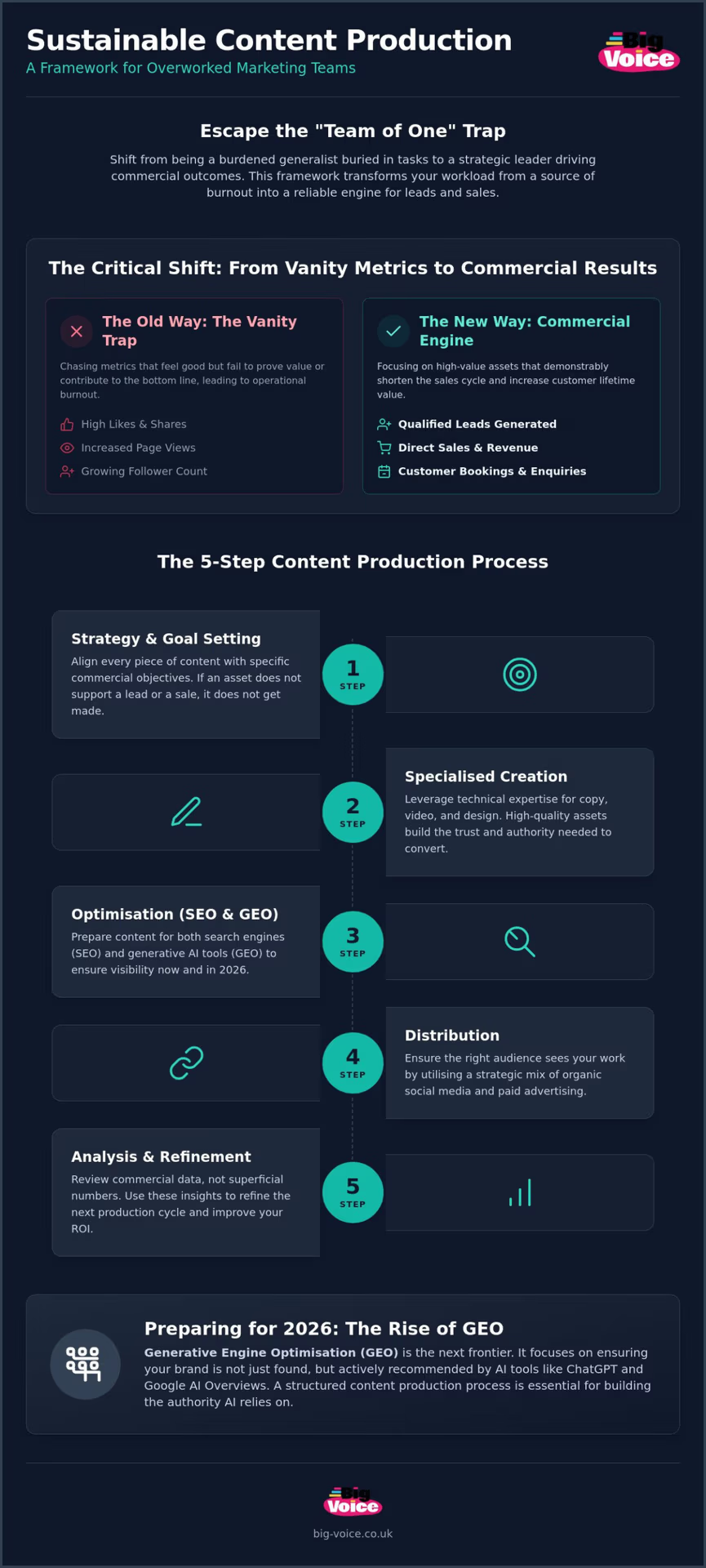
A thousand likes on a post might feel good, but they don’t pay the bills for a Milton Keynes SME. We need to look at commercial markers like bookings, enquiries, and direct sales. If your content isn’t driving people toward a commercial outcome, it isn’t performing. In 2026, ROI-led content production is defined as the strategic creation of high-value assets that demonstrably shorten the sales cycle and increase customer lifetime value through measurable, bottom-line engagement. Focus on the results that your stakeholders actually care about, such as leads generated and sales closed, rather than superficial engagement numbers that offer no real-world impact.
The 5-Step Content Production Process for SMEs
Building a sustainable content production engine doesn’t require a bloated agency team. It requires a repeatable framework that ensures every minute you spend on marketing translates into commercial value. For SMEs, simplicity is your greatest asset. By following a streamlined five step process, you can move away from reactive, impulsive posting and toward a structured system that supports your business growth.
- Strategy and Goal Setting: Align every piece of content with your specific commercial objectives. If it doesn’t support a lead or a sale, don’t make it.
- Specialised Creation: Leverage technical expertise for copy, video, and design. High quality assets build trust and authority with your local Milton Keynes audience.
- Optimisation: Prepare your content for both traditional search engines and the generative AI tools of 2026. This ensures your brand is recommended by tools like ChatGPT and Claude.
- Distribution: Ensure the right eyes see your work. Utilise a mix of organic social media and paid social advertising to reach your target demographics.
- Analysis: Review commercial data rather than vanity metrics. Use these insights to refine your next production cycle and improve your ROI.
Mapping Content to the Buyer Journey
Your potential customers need different information depending on where they are in their journey. At the awareness stage, focus on educational resources that solve immediate problems. For the consideration stage, provide evidence of your expertise through case studies or technical guides. Finally, the decision stage requires clear, low friction calls to action that lead to bookings or enquiries. You can map your buyer journey to identify exactly what your local audience is searching for and ensure you have the right content ready to meet them.
The Importance of Technical Optimisation
Great content fails if it stays hidden. Technical optimisation is the bridge between a creative draft and a commercial result. This involves more than just keywords; it includes metadata, schema markup, and ensuring your content performs perfectly across all mobile devices. Specialist support during this phase ensures your assets are accessible and visible to both humans and AI crawlers. If you’re feeling overwhelmed by the technical side of things, our SEO and GEO services can act as an extension of your team to handle the heavy lifting for you.
Organising Your Team to Prevent Marketing Burnout
Trying to do everything yourself isn’t just inefficient; it’s a recipe for professional exhaustion. Many marketing managers in small teams fall into the “Team of One” trap, where they attempt to master every discipline from graphic design to complex data analysis. This operational overwhelm has a significant psychological impact, leading to a loss of creative spark and a constant feeling of being behind. To build a sustainable content production workflow, you must identify the four core roles required for success: the Strategist, the Creator, the Technical SEO, and the Paid Media Specialist.
In a small business, it’s rarely feasible to hire four full-time experts. This is where the “Extension of the Team” model becomes your secret weapon. By partnering with specialists who integrate seamlessly into your existing structure, you gain high-level agency capabilities without the overhead of a large headcount. It moves the burden of technical execution off your shoulders, allowing you to breathe again. You transition from a state of constant fire-fighting to a position of controlled, strategic growth.
The Specialist vs Generalist Debate
Generalists are invaluable for managing broad goals and maintaining brand consistency. However, specialists almost always win when it comes to technical execution. Whether it’s navigating the latest AI search algorithms or crafting high-converting copy, deep expertise makes the difference between content that sits idle and content that converts. You don’t need to be the expert in everything; you just need to know how to supplement your internal team with external technical authority. For many, this starts with securing expert social media support to handle the daily demands of community engagement and platform updates.
Transforming from Replaceable to Remarkable
When you’re buried in the weeds of technical tasks, it’s difficult to prove your true value to the business. By outsourcing the heavy lifting of content production, you can elevate your role to focus on high-level strategy and commercial growth. This shift allows you to present executive-level data to stakeholders, showing them lead generation figures and ROI instead of just post counts. You stop being the person who “makes things” and become the person who “drives results”. Reducing your burnout often starts with offloading technical burdens like paid social management. This transition makes you remarkable in the eyes of your directors whilst providing the mental relief you’ve been craving.
Content Production in 2026: Optimising for GEO and AI
Search has fundamentally changed. By July 2026, 95% of B2B marketers are using AI-powered applications to streamline their workflows. This shift has introduced Generative Engine Optimisation (GEO), a discipline focused on making your brand visible within AI-generated responses. When a potential client asks ChatGPT or Claude for a recommendation in Milton Keynes, these models don’t just look at keywords. They look for topical authority and evidence of trust across the entire web. Your content production must now serve two masters: the human reader seeking value and the Large Language Model (LLM) seeking verifiable data.
To rank in Google AI Overviews, you need to move beyond simple keyword density. AI engines prioritise content that demonstrates genuine expertise and provides clear, direct answers to complex queries. This means your content production cycle must include a phase for technical validation. You aren’t just writing articles; you’re building a knowledge base that AI agents can confidently cite. Trust is the new currency. If your business isn’t being mentioned as a solution in these generative conversations, you are effectively invisible to a large portion of your target market. These models prioritise original, human-centric expertise over generic, mass-produced text.
The Future of Search: SEO vs GEO
Your content must be readable by both humans and machines. Whilst traditional SEO still matters for driving traffic to your site, GEO ensures your brand is part of the AI’s internal world model. This involves structuring your data so LLMs can extract your business information correctly. You can learn more about mastering ChatGPT Ads and search to stay ahead of this curve. Proper schema markup and clear, declarative sentences help AI models understand exactly what you offer. When you provide structured, factual data, you reduce the risk of AI hallucination and ensure your brand is represented accurately.
Building Trust with Generative Engines
AI models rely on consensus. They look for citations and mentions of your brand across reputable platforms to verify your authority. For SMEs in Buckinghamshire and Hertfordshire, local relevance remains a powerful signal. When local directories, news sites, and industry blogs all point to your expertise, generative engines are much more likely to recommend you. In 2026, the impact of GEO on SME visibility is the difference between being a forgotten name and becoming the primary recommendation for high intent local searches. Consistency across all digital touchpoints is vital. You can optimise your brand for the future of search with our specialist GEO support.
Scaling Your Production with a Local Specialist Partner
Scaling your content production shouldn’t feel like adding more weight to your shoulders. For many marketing managers, the solution isn’t just more content but better, more strategic execution that doesn’t require constant supervision. A local specialist partner acts as the specialist force that makes you look better to your own stakeholders. Unlike a traditional agency that might feel distant or disconnected, a deep collaboration model ensures your partner is a seamless addition to your internal team. You gain the capacity of a full agency with the agility of a local team who understands your specific commercial goals.
The transition from being burdened by tasks to being celebrated for outcomes happens when you stop focusing on output and start focusing on impact. We’ve seen SMEs move from chasing vanity metrics to achieving genuine commercial growth by simply offloading the technical heavy lifting. This shift provides immediate mental relief. You no longer have to worry about the granular details of SEO or the latest AI search updates; instead, you can focus on the high level strategy that drives your business forward. It’s about moving from a state of being stuck to a feeling of moving forward with a clear, expert led plan.
Why Local Knowledge Matters for SMEs
A partner who understands the Milton Keynes business landscape can target customers in Luton, Bedford, and Northampton far more effectively than a generic national agency. There is immense value in working with experts who can meet in person at Cranfield University Technology Park or Central Milton Keynes to discuss your strategy. This local context ensures your brand voice resonates with the regional audience whilst maintaining technical rigor. If you’re looking to expand your reach through social platforms, partnering with a Facebook Ads Agency Milton Keynes can help you drive commercial ROI specifically within our local markets.
Getting Started with a Team Extension
The first step toward scaling is to audit your current process for gaps. Where is your time being wasted? Where do you lack specialist expertise? The first 30 days of working with a specialist partner should focus on identifying these friction points and building a repeatable workflow. This period is about establishing trust and proving the value of the partnership through immediate technical support. By integrating a PPC Agency Milton Keynes into your content production engine, you can ensure your high quality assets are supported by a robust paid strategy from day one. You deserve a partner who is deeply invested in your personal and professional ease, helping you look remarkable to your stakeholders whilst you regain control of your time.
Build a Sustainable Marketing Engine for the Future
You now have the framework to move away from the “Team of One” trap and toward a strategy that prioritises commercial ROI over vanity metrics. By embracing a structured five step process and optimising for the AI search landscape of 2026, you can finally find the professional relief you’ve been seeking. Effective content production shouldn’t be a source of burnout; it should be the engine that drives your business forward whilst allowing you to focus on high level strategy.
You don’t have to navigate this transition alone. With our 5-star Google review status and local specialist expertise in Milton Keynes, we provide the technical depth and support needed to make your team remarkable. We focus on real-world impact and measurable success, acting as a seamless extension of your existing structure. Ready to reclaim your time and elevate your professional reputation? Find relief for your marketing team today and let us handle the technical heavy lifting. You’ve got the vision; let’s build the results together.
Frequently Asked Questions
What is the most important part of the content production process?
The most important part of content production is the initial strategy and goal setting phase. Without a clear commercial objective, you are simply creating noise that won’t drive ROI. Every piece of content must serve a specific purpose in the buyer journey, whether that is solving a problem for a new lead or providing the technical proof needed to close a sale. Aligning your output with your business goals ensures your efforts translate into revenue.
How much content should a small business produce every week?
Quality should always take precedence over volume for a small business. Producing one or two high value assets per week is far more effective than posting daily content that lacks depth or purpose. Strategic content production focuses on creating evergreen resources that continue to generate leads long after they are published. Focus your limited energy on assets that demonstrate your authority and provide genuine value to your target audience in the Milton Keynes area.
Can I use AI to handle all my content production in 2026?
You cannot rely on AI to handle every aspect of your production in 2026. Whilst 95% of B2B marketers now use AI tools, the market places a higher value on human generated, trustworthy content. Regulations like the EU AI Act and FTC disclosure rules require transparency regarding synthetic content. Human expertise is essential for maintaining a unique brand voice and ensuring your content remains original, empathetic, and compliant with evolving legal standards.
How do I measure the ROI of my content production efforts?
You measure ROI by tracking commercial markers such as leads, bookings, and direct sales rather than vanity metrics. Use attribution modelling to see which specific assets are contributing to your bottom line. Content marketing generally generates three times more leads than outbound methods at a much lower cost. By focusing on these hard numbers, you can provide the executive level data your stakeholders need to see the true value of your marketing efforts.
What is the difference between an agency and a team extension?
A traditional agency often operates as an outside entity with a hands off approach to your daily operations. In contrast, a team extension acts as a collaborative partner that integrates seamlessly into your existing structure. This model provides the specialist technical force you need whilst making you look better to your directors. It offers a sense of professional relief by taking on the heavy lifting of execution, allowing you to remain the strategic lead.
Is content production still relevant for local SEO in Milton Keynes?
Content is absolutely vital for local SEO and the newer discipline of Generative Engine Optimisation. AI models like ChatGPT and Claude look for local citations and mentions across the web to verify your authority in Milton Keynes. Without consistent, high quality production, your business won’t appear as a recommended solution in local AI search results. Maintaining a strong digital presence ensures you stay visible to customers in Buckinghamshire who are using generative tools to find services.
How can I prevent my marketing team from burning out?
Preventing burnout requires you to identify and offload the technical tasks that cause operational overwhelm. Stop trying to be a generalist who masters every single discipline from video editing to SEO. By supplementing your internal team with specialist support, you can shift your focus from fire fighting to high level strategy. This transition reduces your mental workload and allows you to be celebrated for outcomes rather than just being burdened by a never ending list of tasks.
What technical skills are required for modern content production?
Modern production requires a blend of technical SEO, data analysis, and an understanding of GEO. You need to know how to structure data for AI crawlers and how to use technical distribution channels like paid social effectively. Whilst prompt engineering is a useful skill in 2026, the ability to interpret commercial data and refine strategy based on ROI is even more critical. Specialist partners can provide these technical skills, acting as the expert sidekick your team needs.
